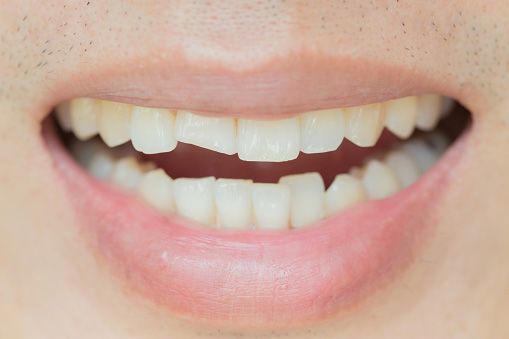
If you chip a tooth, rinse your mouth with warm water, save any piece that broke off and use a cold compress for swelling. Then call your dentist. A small chip that does not hurt is usually not an emergency, yet it should still be repaired so a sharp edge does not cut your tongue or lips.
Chips happen in ordinary moments: biting down on something hard, a fall or a ball to the face during a game. How a chipped tooth is treated depends on how much of the tooth broke and whether the inner layers were affected, which is why a dental exam is the next step even when the damage looks minor.
What should you do right after you chip a tooth?
These first steps follow guidance from the American Dental Association and MedlinePlus:
- Rinse. Rinse your mouth with warm water to clean the area.
- Ease swelling. Hold a cold compress on the outside of your face or mouth to help with pain and swelling.
- Control bleeding. If the gums or lips are bleeding, press gently with clean gauze.
- Save the piece. Keep any broken fragment and bring it with you. The American Association of Endodontists notes that many chipped teeth can be repaired by reattaching the broken piece.
- Skip aspirin on the gums. The ADA advises against putting aspirin directly on an aching tooth or gums because it may burn the gum tissue.
- Call your dentist. Describe what happened and whether the tooth hurts so the office can decide how soon you should be seen.
Is a chipped tooth an emergency?
Not always. MedlinePlus explains that a simple chip that is not causing discomfort may not need an emergency visit. It also advises contacting your dentist right away when a tooth is broken or knocked out.
Call promptly if the tooth hurts, if a large part of it broke off or if the chip came from a hard blow to the face. If you cannot close your upper and lower teeth together after an injury, MedlinePlus notes that the jaw may be broken, so seek medical care right away. Our Where does it hurt? symptom guide can help you sort out how urgent your situation is.
How do dentists fix a chipped tooth?
The repair depends on the size and location of the break. Common options include:
- Reattaching the fragment. When the broken piece is saved and intact, it can sometimes be bonded back onto the tooth.
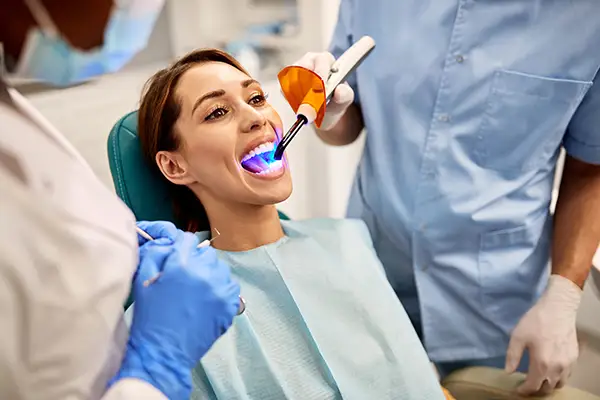
- Bonding. According to the AAE, most chipped teeth can be repaired by reattaching the piece or by bonding a filling in its place. Composite dental bonding uses tooth colored resin to rebuild the missing part of the tooth.
- A crown. When more of the tooth is missing, the ADA notes that a crown can restore a tooth that is already broken and protect a weak tooth from breaking further.
- Root canal treatment. If the break reaches the pulp, the AAE explains that the tooth can often be treated with a root canal and a crown.
A broken pointed part of a back tooth, called a fractured cusp, rarely damages the pulp according to the AAE. A new filling or crown is usually placed to protect it.
Will a chipped tooth heal or grow back?
No. The AAE points out that unlike a broken bone, a fracture in a tooth will not heal. The AAE also notes that an untreated cracked tooth can get worse over time, so a dentist needs to restore it. Even a small chip with no pain is worth repairing, since MedlinePlus notes that a sharp edge can cut your lips or tongue.
Tiny surface lines in the enamel, called craze lines, are different. The AAE describes them as very shallow and painless with no concern beyond appearance. If you are not sure whether you have a chip or a crack, our guide to cracked teeth symptoms and types explains the differences.
How can you prevent chipped teeth?
- Avoid chewing ice, popcorn kernels and hard candy, which the ADA lists as foods that can crack a tooth.
- Wear a mouthguard for contact sports, as MedlinePlus recommends.
When to see a dentist
Any chipped tooth should be examined. Pain, sensitivity or a large break are reasons to call the same day. Our office at 2875 Middlefield Road in Midtown offers same day emergency visits Monday through Thursday and Friday mornings for patients from Palo Alto and nearby Menlo Park. Dr. Sharma also serves as a team dentist for Stanford Sports Medicine, so he is familiar with tooth injuries from sports.
At the visit, Dr. Sharma will examine the tooth, check whether the inner layers are involved and explain which repair fits your situation before any treatment begins.
Common questions
Does a chipped tooth hurt?
Often it does not. The AAE notes that a fractured cusp usually does not cause much pain. Pain, lingering sensitivity or pain when biting can mean the damage goes deeper, so it is a reason to have the tooth checked soon.
Can I fix a chipped tooth at home?
No. Home care can keep you comfortable until your visit, yet a chip will not repair itself. A dentist needs to repair or protect the tooth so the break does not grow and the sharp edge does not injure your mouth.
What if I chip a tooth playing sports?
Follow the same first steps and call your dentist. If a permanent tooth is knocked out completely, MedlinePlus advises holding it by the crown, keeping it moist in milk or saliva and getting to a dentist as soon as possible. MedlinePlus also recommends wearing a mouthguard for any contact sport.
Chipped a tooth or have a question about a repair? Request an appointment or call us at (650) 321-9693.
Sources
Dental Emergencies, MouthHealthy (American Dental Association)
Crowns, MouthHealthy (American Dental Association)
Broken or Knocked Out Tooth, MedlinePlus (U.S. National Library of Medicine)
Cracked Teeth, American Association of Endodontists
This article provides general education and does not replace an individual dental examination or diagnosis.